Inside Monte Alban: A Complete Guide to Every Structure, Plaza and Carving
The short answer
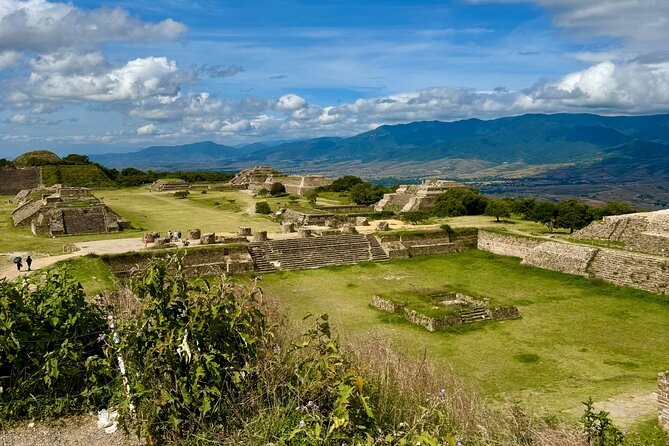
The Main Plaza is a levelled rectangle about 300 metres by 150, with a great platform closing each end, a range down the east side, two matching complexes on the west and Building J alone in the middle. Walk it anticlockwise from the South Platform. Give it two hours, three if you want the museum.
The shape of the site, before you set off
Start with the ground itself, because the ground is the largest thing anyone built here. The summit of the ridge was cut down and filled out by hand until it formed a level rectangle, and the terraces and canals that hold it in place run down every slope. Everything else stands on that platform.
Once you know the plaza runs north to south, the site stops being a scatter of mounds and becomes a plan. Six things sit on it, and this is the order to meet them in.
1. The South Platform, and why you climb it first
The southern end of the plaza is closed by a broad stepped platform, and it is the one climb almost everyone makes. Do it first, while your legs are fresh and the light is still low.
From the top you get the whole site in a single frame, with the valley falling away on three sides beyond it. Nothing else here explains the scale of the levelling so quickly. The stairway is steep and has no handrail, so take it slowly and use the flat ground at the top for photographs.
2. Building J, the one that faces the wrong way
Alone in the centre of the plaza is a building shaped like an arrowhead, set at an angle to everything around it. Nothing else on the ridge shares its orientation.
Its walls carry more than forty carved slabs from the site's second phase. Each pairs a place-name glyph with an inverted head beneath it, which in Mesoamerican shorthand means a settlement brought under control. Read together they are a list. Whether that list records conquests or advertises them is still argued, and it is the most interesting argument you can stand inside on this hill.
3. Los Danzantes, on the west side
Set into a wall on the western range are the carved stones known as Los Danzantes, which gave the building its popular name. Over three hundred have been recorded. The figures are naked, their limbs are loose, their eyes are often closed, and nineteenth-century observers read the postures as dance.
They are almost certainly captives: tortured or sacrificed, several named by the glyphs beside them. They belong to the earliest phase of the site, which makes them among the oldest monumental carvings in the valley. Many originals have been moved into the museum over ninety years of excavation, so plan on seeing both.
4. Systems IV and M
North of the Danzantes, along the same western side, stand two complexes built to nearly the same design: a temple on a platform behind a walled forecourt, each with its own courtyard. They face the eastern range across the open plaza.
The repetition is the point. Whatever these were for, there were two of them, deliberately alike and deliberately paired. That tells you something about how the plaza was used even though it does not tell you what happened inside.
5. The North Platform and its staircase
The northern end carries the largest structure on the site, reached by a monumental staircase that is itself among the more impressive pieces of engineering here. On top is a sunken patio ringed by its own buildings — effectively a second, private plaza raised above the public one.
Climb it for the sense of scale rather than the view. Standing at the head of that staircase and looking the length of the plaza is the clearest demonstration available of what the levelling actually achieved.
6. The ball court, on the way back
At the northern end of the eastern range is a sunken court shaped like a capital I, with sloping sides and stone benches. It is one of two known at the site.
There are no stone rings here of the kind at Chichen Itza, and the sloping walls were probably playing surfaces rather than seating. What the game meant at this particular place is not established, and a guide who tells you otherwise is filling a gap rather than reporting one.
| Stop | Where | Give it |
|---|---|---|
| South Platform | South end | 20–25 min |
| Building J | Centre | 15–20 min |
| Los Danzantes | West side | 20 min |
| Systems IV and M | West side, north | 10 min |
| North Platform | North end | 20–25 min |
| Ball court | East side, north | 10 min |
| Site museum | By the entrance | 20 min |
Three things most visitors walk past
- El Palacio, on the east side: a courtyard building of domestic rather than ceremonial plan, and a reminder that people lived up here as well as processing across it.
- The terraces beyond the plaza, north of the main group, where the residential city actually was and where the painted tomb entrances are cut.
- The site museum, included in your ticket, holding carvings brought indoors to keep them out of the weather.
The full reference, structure by structure, is on the structures, and the layout with a numbered walking order is on the site map.
Where to stand for photographs
Three frames are worth planning for. The whole-plaza shot is from the top of the South Platform with the sun behind you, which means the first two hours after opening. The carvings want raking light rather than overhead sun, so they are better early too.
The third is the one almost nobody takes: walk out past the North Platform, turn around, and shoot back down the length of the plaza with the valley dropping away on both sides. That frame is the only one that shows you what the levelling actually did, and it costs you ten minutes of walking.
Doing this walk with a guide, or without one
Everything above is walkable on your own with this page open, and if that is your preference then go at eight, take the route in this order and give yourself three hours. Practical detail is on visitor information.
What you will not get is the argument. Whether Building J's slabs are a record or a claim, why the Danzantes were re-read, what broke at the end of the Early Classic — that is what a guide is carrying, and it is why a Monte Alban tour converts a field of platforms into a city with a history. The background is on history either way.
Next step: see which mornings give you three hours on the plaza rather than ninety minutes, on Monte Alban Tours.
Tours with the most time on the plaza
Monte Alban Guided Half Day Tour
Three guided hours on the plaza from an office by the Cathedral. Ticket paid at the gate.
From $32 per person
Check Availability
Private Tour to Monte Alban Half Day
A private morning with the site tickets bought for you and three hours on the plaza.
From $236 per group, up to 4
Check Availability