14 Facts About Monte Alban That Will Surprise You
The short answer
A mountaintop levelled by hand, three hundred carvings of tortured captives, a building that faces the wrong way and carries a list of conquered towns, a Zapotec tomb reopened by Mixtecs and filled with gold, and a ticket price that doubled at the start of this year. Fourteen of them, all checked.
1. The mountaintop is the building
The Main Plaza is not a natural plateau. The summit of the ridge was cut down and filled out by hand until it formed a level rectangle roughly 300 metres by 150, and the terraces, dams and canals that hold it in place run down every slope. The largest piece of construction here is the ground you walk on, and you will not notice it unless somebody tells you.
2. Nobody lived on the plaza
At its height something like 35,000 people lived at Monte Alban, and almost none of them lived on the summit. The population occupied terraced platforms cut into the slopes below, all the way round the hill. What survives above ground is the civic stage; the city was the mountain underneath it.
3. It was built somewhere deliberately inconvenient
There is no spring on the ridge, no farmland on the slope and nothing that a lower hill would not also have offered. What the site does have is a view down all three arms of the Valley of Oaxaca at once, and a position belonging to none of the settlements already in them. The founding reads as a political decision rather than a practical one. You can see the argument for yourself from either platform: three valleys, three directions, and no obvious reason to be up there except to be seen from all of them.
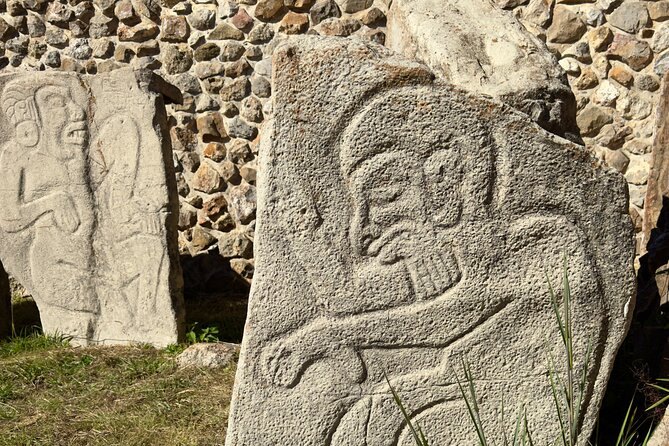
4. The "dancers" are nothing of the kind
Over three hundred carved stones known as Los Danzantes were named for their loose, contorted postures. The modern reading is that they show tortured or sacrificed war captives, several identified by name in the glyphs beside them. The name stuck anyway, which is why almost every sign and guidebook still uses it.
5. One building carries a list of conquests
Building J sits alone in the centre of the plaza and carries more than forty carved slabs. Each pairs a place-name glyph with an upside-down head, the standard shorthand for a settlement brought under control. Alfonso Caso read the set as a record of conquests. Whether it records them or claims them is still open.
6. And it faces the wrong way
Building J is an arrowhead in plan and is set at an angle to every other structure on the plaza. Nothing else here shares its orientation, and no explanation for that is settled — which has not stopped a great many being offered.
7. You can still climb almost everything
The stairways on both great platforms are open to you, at a time when the main pyramids at Chichen Itza and Teotihuacan have been roped off for years. It is the single strongest practical reason to choose this site over a more famous one, and you should not assume it will last. Take the steps slowly when you do: they are worn, uneven and have no handrail anywhere on either climb.
8. The most famous thing found here was Mixtec, not Zapotec
Tomb 7 was cut by Zapotecs during the Classic period and reopened centuries later by Mixtecs, who buried one of their own elite in it with an offering of worked gold, turquoise, jade, rock crystal, pearl and carved bone. It is among the richest burial offerings ever recovered in Mesoamerica, and it came out of somebody else's tomb.
9. It was found in 1932, and it made a career
Alfonso Caso opened Tomb 7 a year after beginning work here. The find put Monte Alban into every history of Mexican archaeology, and the ceramic chronology Caso built with Ignacio Bernal and Jorge Acosta is still the framework the site's phases hang on.
10. The city's real size was not known until the 1970s
For forty years after Caso, Monte Alban was understood as a ceremonial centre. It took Richard Blanton's settlement-pattern survey, walking the terraces from the early 1970s, to establish that this was a city of tens of thousands. The monuments had been excavated for decades before anyone counted the houses.
11. It kept company with Teotihuacan, then stopped
Through the Early Classic the connection with Teotihuacan shows in the architecture, the ceramics and the mural painting. At the end of that period the link breaks, clearly enough to be visible in the record. What followed was not collapse but a long change of character.
12. Two Zapotec capitals share one ticket price and nothing else
Mitla, forty kilometres east, is the other great Zapotec site of the valley and costs exactly the same to enter. It could hardly look less alike: geometric stone fretwork on low buildings against a levelled hilltop of platforms. The comparison is worked through in Monte Alban vs Mitla.
12b. The five phases, if you want the frame
| Phase | Dates | What it left |
|---|---|---|
| Monte Alban I | c. 500–300 BC | The founding and the Danzantes |
| Monte Alban II | c. 100 BC–AD 200 | Building J and its slabs |
| Monte Alban IIIA | c. AD 200–500 | The Teotihuacan connection |
| Monte Alban IIIB / IV | c. AD 500–1000 | Full size, then the unwinding |
| Monte Alban V | Postclassic | Mixtec reuse and Tomb 7 |
Those dates are Caso's, built on excavated ceramics from 1931 onward, and you will find them on every subsequent account of the site.
13. The protected zone is far bigger than the bit you walk
The archaeological zone covers 2,078 hectares and reaches into four municipalities. The plaza that visitors cross is a small fraction of it, and the entrance stands in Santa Cruz Xoxocotlan rather than in the city of Oaxaca at all.
14. The entry price for foreign visitors doubled this January
Until 31 December 2025 everyone paid MX$100. From 1 January 2026 a foreign visitor pays MX$210 and a Mexican national or resident pays MX$105. Almost nothing on the internet has caught up, which is why so many people arrive with the wrong amount of cash in their pocket.
Where the stories get told on the spot
None of the above is written on a board at the site. The plaza carries almost no interpretation, and what there is sits in Spanish. Everything here is drawn from the excavation record, which is set out on history, and from the structures themselves, described on the structures.
If you would rather hear it than read it, that is the argument for a guide, and it is why the best Monte Alban tour for most first visits is simply the one with a good one. Practical detail before you go is on visitor information, and the layout is on the site map.
Next step: find a guide who can tell you which of these is settled and which is argued, on Monte Alban Tours.
Where the story gets told on the spot

Monte Alban for 3hrs, Black Pottery and Alebrijes with Admissions
Two and a half hours on the ridge with the ticket in the fare, then two workshops.
From $50 per person
Check Availability
Tour de medio día a monte alban
Collected from your hotel at 8:30, back by lunch, with a bilingual guide throughout.
From $32 per person
Check Availability